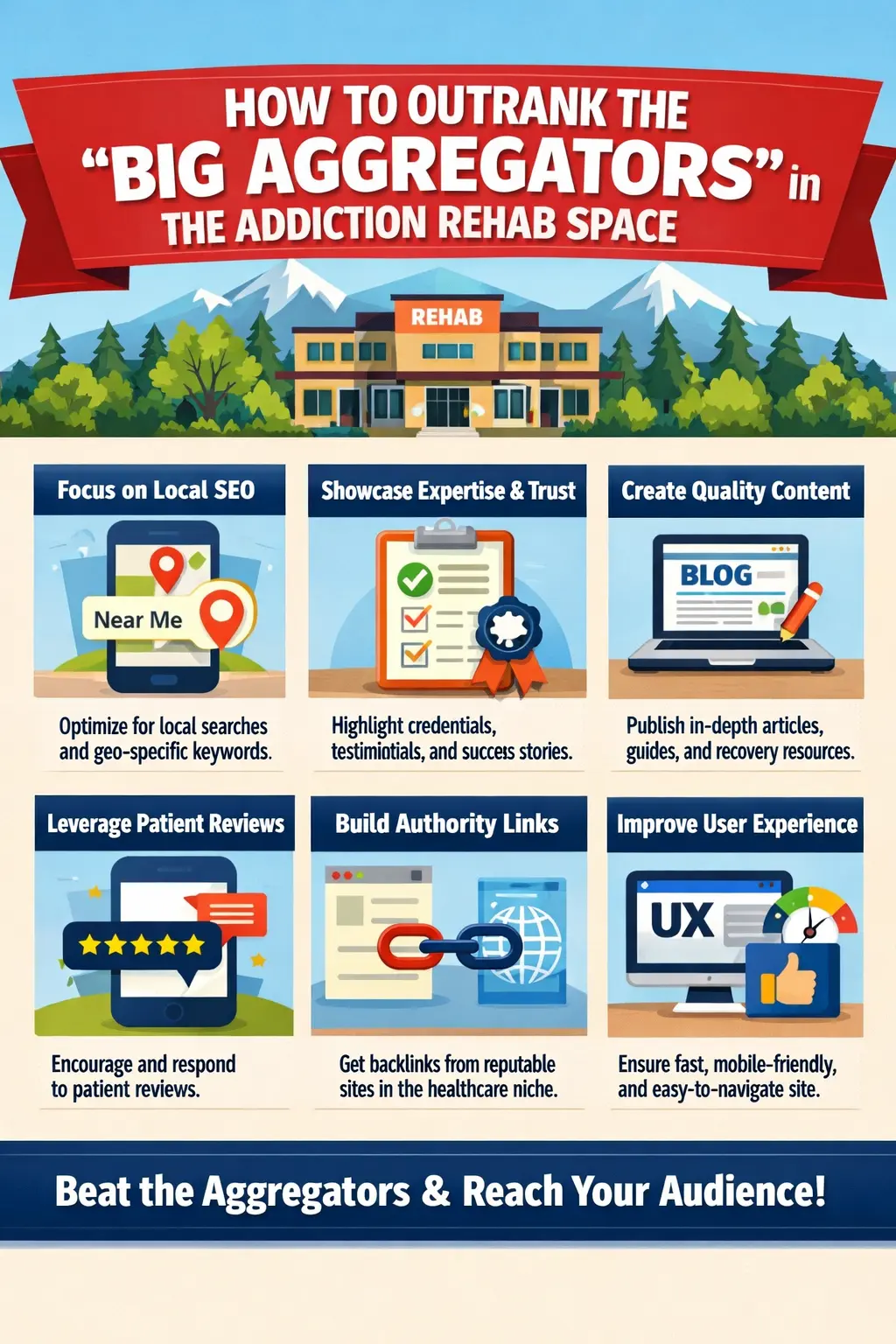
Why Boutique Clinics Feel Bullied by Referral Directories
If you run a private rehab or addiction treatment clinic in Australia, Thailand, Bali USA or the UK you’ve felt it.
Massive referral directories dominate Google like Recovery.com, Thailand Rehab Guide or Addiction Centre. They rank for everything. And when they send you a lead, they take a huge commission—sometimes 20–40% of your treatment fees….who do you think is paying for their marketing? You are!
These aggregators don’t provide care. They don’t employ clinicians. They don’t carry clinical risk. Yet they sit between you and your future clients, controlling visibility and inflating acquisition costs.
Key Takeaways
- Aggregators profit by sitting between clinics and clients, often charging 20–40% commissions without providing care.
- Create detailed, location-specific service pages that reflect real expertise, local context, and patient needs.
- Optimise your Google Business Profile to capture visibility in local search and map results.
- Publish authoritative, clinician-led content to position your clinic as a trusted medical provider—not just a listing.
- Owning your local market leads to lower acquisition costs and stronger brand control.
- You don’t need to beat aggregators everywhere—just where it matters most: your local area.
For many boutique clinics, it feels less like marketing and more like extortion by algorithm.
But here’s the good news:
Google doesn’t actually want directories to win every search. And with the right Local SEO strategy, smaller clinics can—and do—outrank national aggregators for high-intent searches like:
- Best rehab Sydney
- Drug rehab Thailand
- Alcohol rehab Texas
- Private rehab near me
At Rehab SEO, this is exactly what we specialise in.
Why Big Aggregators Rank (And Why That Advantage Is Overstated)
To beat them, you first need to understand why they rank.
National directories succeed because they have:
- Large backlink profiles
- High domain authority
- Thousands of indexed pages
- Aggressive SEO budgets
But they also have critical weaknesses—especially at the local level.
The Key Problem with Aggregators
They are:
- Broad, not specific
- National, not local
- Generic, not experiential
Google’s algorithm has evolved significantly. Today, it rewards:
- Local relevance
- Demonstrated expertise
- Real-world signals
- Proximity and trust
This is where boutique clinics can outperform them—without matching their budget.
The Strategic Shift: Stop Competing Nationally, Start Dominating Locally
One of the biggest mistakes clinics make is trying to rank for vague, national keywords like:
- Drug rehab Australia
- Addiction treatment centre
- Rehab clinic Los Angeles
These are aggregator territory.
Instead, Local SEO flips the battlefield.
What Local SEO Actually Means for Rehabs
Local SEO is not just “adding your suburb to a page.”
It’s a structured strategy designed to ensure your clinic is the most relevant result for people searching near you—at the exact moment they need help.
When done properly, Google starts to see your clinic as:
“The best answer for people seeking addiction treatment in this specific location.”
And that is incredibly powerful.
Step 1: Build Location-Focused Service Pages That Aggregators Can’t Replicate
Directories rely on templated pages. Boutique clinics can create deep, authentic local pages.
What a High-Performing Local Rehab Page Includes
For example: “Drug & Alcohol Rehab in Sydney’s Eastern Suburbs”
It should include:
- Clear description of services in that location
- References to nearby suburbs and landmarks
- Local admission pathways and travel considerations
- On-site or nearby accommodation details
- Clinician expertise and treatment philosophy
- Unique FAQs relevant to that community
Aggregators can’t do this authentically at scale.
Google knows the difference.
Step 2: Own “Best Rehab + Location” Searches the Right Way
Searches like “Best rehab London” are high-value—and highly contested.
Contrary to popular belief, Google does not automatically prefer directories here.
It looks for authority signals, including:
- On-site expertise
- Consistent brand mentions
- Reviews and reputation
- Local engagement signals
How Boutique Clinics Win These Terms
At Rehab SEO, we focus on:
- Positioning your clinic as a specialist provider, not a listing
- Publishing authoritative, clinician-reviewed content
- Structuring pages to clearly answer “why this clinic is best”
- Supporting claims with trust signals (not hype)
This shifts your site from “another clinic” to the local authority.
Step 3: Google Business Profile Optimisation (A Massive Missed Opportunity)
Most clinics severely underutilise their Google Business Profile (GBP).
Yet for local rehab searches, GBP is often the first thing users see.
What Separates High-Ranking Rehab Profiles
- Correct primary and secondary categories
- Detailed service descriptions (not generic text)
- Regular updates and posts
- Accurate service areas
- High-quality, authentic photos
- Consistent NAP (Name, Address, Phone) across the web
Aggregators can’t fully optimise individual clinic profiles.
You can.
Step 4: Reviews That Signal Trust, Not Marketing
Google’s local algorithm heavily weighs review quality and context, not just star ratings.
Five stars alone won’t cut it.
What Google Is Actually Reading
- Mentions of treatment types (alcohol, drug, gambling)
- Location references
- Staff names
- Depth and authenticity of experience
- Review velocity over time
A clinic with fewer but richer reviews often outranks a directory with hundreds of shallow ones.
Rehab SEO helps clinics build compliant, ethical review strategies that strengthen rankings and trust.
Step 5: Authority Content those Aggregators Can’t Compete With
- Directories summarise.
- Clinics treat.
That difference matters.
Content That Moves the Needle
Examples include:
- Clinician-led insights on treatment approaches
- Localised addiction trends and challenges
- Funding and admission guidance specific to Australia
- Long-form educational content supporting local pages
This positions your site as a medical and clinical authority, not a marketing platform.
Google increasingly rewards this depth.
Step 6: Local Backlinks That Actually Matter
Not all links are equal.
One link from a relevant local source can outweigh dozens of generic directory links.
High-Impact Local Link Sources
- Local health organisations
- Community partnerships
- Medical and allied health referrals
- Local media mentions
- Professional associations
Aggregators struggle to earn these organically.
Boutique clinics don’t—when guided correctly.
The Result: Fewer Commissions, Higher-Quality Admissions
When Local SEO is done properly:
- You reduce dependency on aggregators
- You attract direct enquiries
- You control your brand narrative
- You lower acquisition costs
- You speak directly to families in crisis—without a middleman
Most importantly, you stop paying to access your own market.
Why Rehab SEO Is Different
Rehab SEO isn’t generic SEO.
We specialise exclusively in:
- Addiction treatment
- Mental health services
- Australian & American compliance and healthcare regulations
- High-stakes, high-intent search behaviour
We understand:
- How families search in crisis
- How Google evaluates medical authority
- How to outrank directories without unethical tactics
And we know how to turn rankings into real admissions, not just traffic.
Final Thoughts
You only need to beat them where it matters most.
- Your suburb
- Your city
- Your service area
Local SEO allows boutique clinics to reclaim visibility, authority, and independence—without playing the aggregator’s game.
If you’re ready to stop being overshadowed by directories and start owning your local market, Rehab SEO can help you get there.