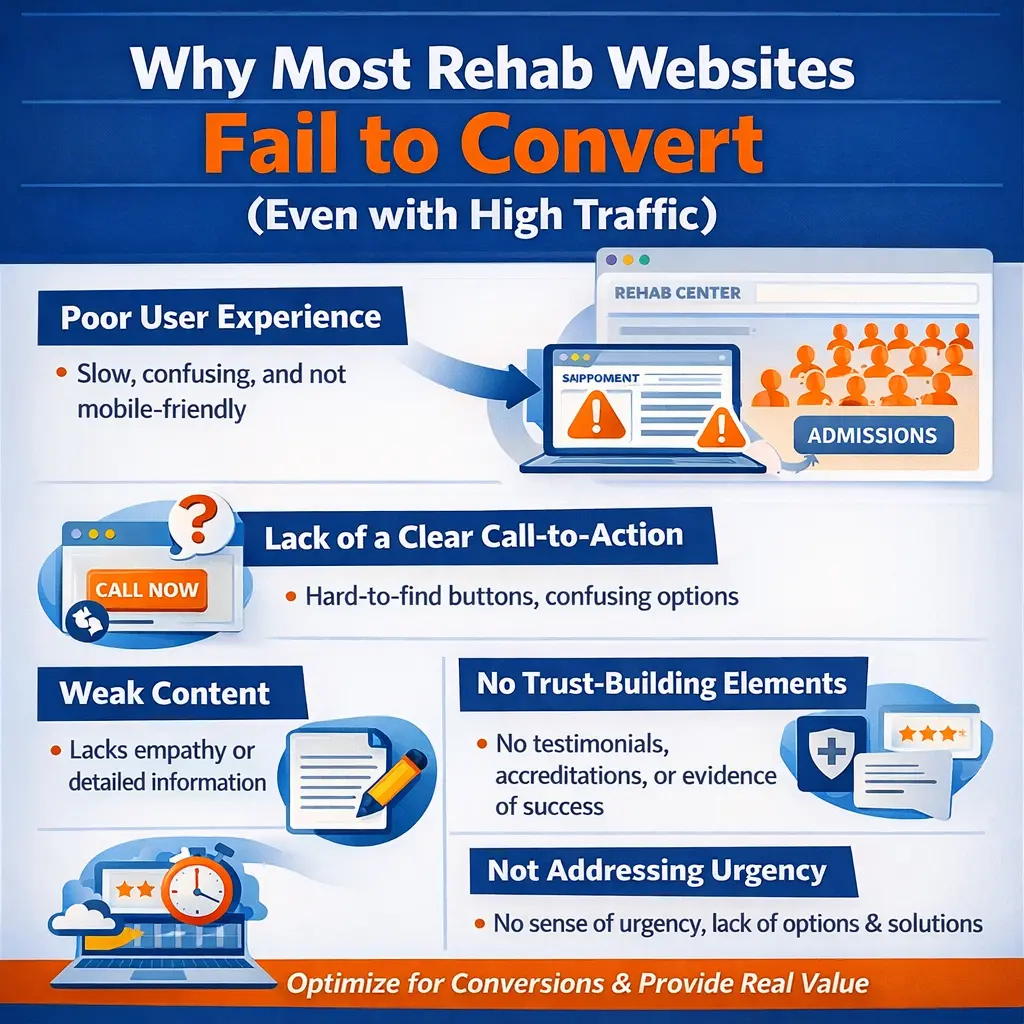
Traffic Isn’t Enough: The Empty Bed Problem
It’s a scenario that keeps clinic directors awake at night:
- Your website is attracting thousands of visitors.
- You rank for top rehab-related keywords.
- Your blog traffic and organic leads are growing.
Yet your beds remain empty.
High traffic is meaningless if visitors don’t convert. In the addiction treatment space, where decisions are urgent and emotional, a visitor who hesitates or struggles to contact your clinic often becomes lost revenue—or worse, untreated crisis.
At Rehab SEO, we see this constantly: the problem is rarely awareness; it’s Conversion Rate Optimization (CRO)—and the solution starts with understanding how crisis-driven searches behave.
The High-Stress Reality of Rehab Searches
Unlike typical healthcare inquiries, rehab searches are often urgent, emotional, and anxiety-laden.
When someone searches for:
- “Drug rehab near me—admissions today”
- “Alcohol detox emergency”
- “Private rehab for spouse”
they are typically in a state of crisis.
Their cognitive bandwidth is limited. They may be stressed, scared, or confused. If your website is slow, cluttered, or difficult to navigate on mobile, they leave—and rarely return.
Even top-ranking clinics lose these high-intent leads because their site wasn’t built for fast, decisive action.
Why Traditional Rehab Websites Fail
Most rehab websites are built with the wrong priorities:
- Desktop-Centric Design
- Many sites still prioritise desktop layouts, ignoring that over 70% of rehab searches happen on mobile.
- Critical conversion elements (like phone numbers, contact forms, or live chat) are hidden below the fold or buried in menus.
- Information Overload
- Long, dense pages about programs, treatment philosophy, and insurance can overwhelm.
- Visitors seeking immediate guidance may bounce before understanding what to do next.
- Weak Calls-to-Action (CTAs)
- “Learn More” buttons or generic contact forms fail in a crisis context.
- Visitors want immediate connection, not website exploration.
- Lack of Trust Signals
- In healthcare, particularly addiction treatment, trust is paramount.
- Without visible clinician profiles, testimonials, or compliance assurances, visitors hesitate—even if they already intend to call.
These flaws result in high traffic, low conversion, and missed admissions.
The Phone-First Philosophy: Optimizing for Crisis Calls
At Rehab SEO, we address this gap with a Phone-First design philosophy.
What Phone-First Means
- Every website element is designed around making the phone call easy, urgent, and stress-free.
- Mobile users see prominent click-to-call buttons, “Call Now” banners, and simplified menus.
- Every page anticipates urgent decision-making rather than passive browsing.
In practice, this approach aligns with how most rehab searches occur: someone in crisis wants to talk to a human, now.
Key Elements of Phone-First Design
- Sticky Call Buttons
- Always visible, even while scrolling.
- Large enough to tap easily on any device.
- Strategically placed above the fold on every page.
- Simplified Lead Capture Forms
- Minimise required fields to reduce friction.
- Offer a “Call Me Now” option instead of long online forms.
- Provide reassurance that privacy and urgency are respected.
- Immediate Access to Support
- Live chat or direct messaging integrated for high-stress visitors.
- Clear messaging about crisis support, intake hours, and confidentiality.
- Pages that guide the caller to action without distractions.
Content That Converts in a High-Stress Context
Conversion isn’t just about buttons—it’s also about words, tone, and structure.
- Clear, Concise Messaging
Visitors must instantly understand:
- What treatment is offered
- Who will help them
- How fast help is available
- How to reach someone immediately
Example:
“Struggling with alcohol or drug dependency? Our admissions team is available 24/7 to guide you or your loved one—call now.”
- Crisis-Focused Headlines
- “Need Rehab Today?”
- “Confidential Help for Families and Loved Ones”
- “Immediate Admissions Available”
These signal urgency and reassure visitors they are in the right place.
- Trust-Building Elements
- Clinician profiles, qualifications, and specialisations
- Testimonials from families (anonymised for privacy)
- Accreditation and compliance badges
- Clear privacy and consent statements
Trust reduces hesitation, which increases conversion in high-stakes decisions.
UX & CRO Tactics That Make a Measurable Difference
Fast Load Times
- Google research shows 53% of mobile users abandon sites that take longer than 3 seconds.
- Every second shaved off increases the likelihood of a call.
Minimal Navigation
- One- or two-click pathways to phone numbers and forms
- Avoid overwhelming menus and hidden links
Visual Cues
- Directional arrows or contrasting colors pointing to call buttons
- Hero sections focused on action, not stock imagery
A/B Testing
- Continuously test CTA placements, messaging, and forms
- Measure click-to-call rates, not just form submissions
These CRO principles ensure traffic converts into admissions, not just pageviews.
Why Phone-First Sites Outperform Traditional Rehab Websites
When clinics adopt a Phone-First, CRO-centric design:
- Conversion rates rise dramatically—often 2–5x higher than standard sites
- Leads come earlier in the decision cycle, capturing users before they explore directories
- Patients and families experience less friction, improving satisfaction
- Clinics reduce dependency on paid marketing channels
High traffic becomes high-value traffic, not vanity numbers.
Rehab SEO’s Approach to Crisis-Converting Websites
At Rehab SEO, we specialise in:
- Audit & Analysis
- Identify friction points that prevent high-intent visitors from calling.
- Phone-First Redesigns
- Mobile-optimised, conversion-focused layouts built for crisis action.
- Content Strategy
- Messaging, headlines, and microcopy designed to guide urgent decision-making.
- Ongoing CRO Testing
- Continuous A/B testing to improve click-to-call rates, form submissions, and lead quality.
This combination ensures that traffic is not wasted—every visit has the potential to turn into an admission.
Final Thoughts
In the high-stakes world of addiction treatment, traffic alone does not pay bills or save lives.
Empty beds in high-traffic clinics are almost always a CRO problem, not a marketing failure.
By embracing Phone-First design, simplifying navigation, optimising content for crisis-driven searchers, and building trust, clinics can:
- Capture more high-intent calls
- Convert worried families into immediate admissions
- Reduce reliance on aggregators and paid leads
- Position themselves as the empathetic, trustworthy choice
At Rehab SEO, we turn website traffic into real-world outcomes—helping clinics fill beds and save lives.